Lord Ayyappan Sabari Portal
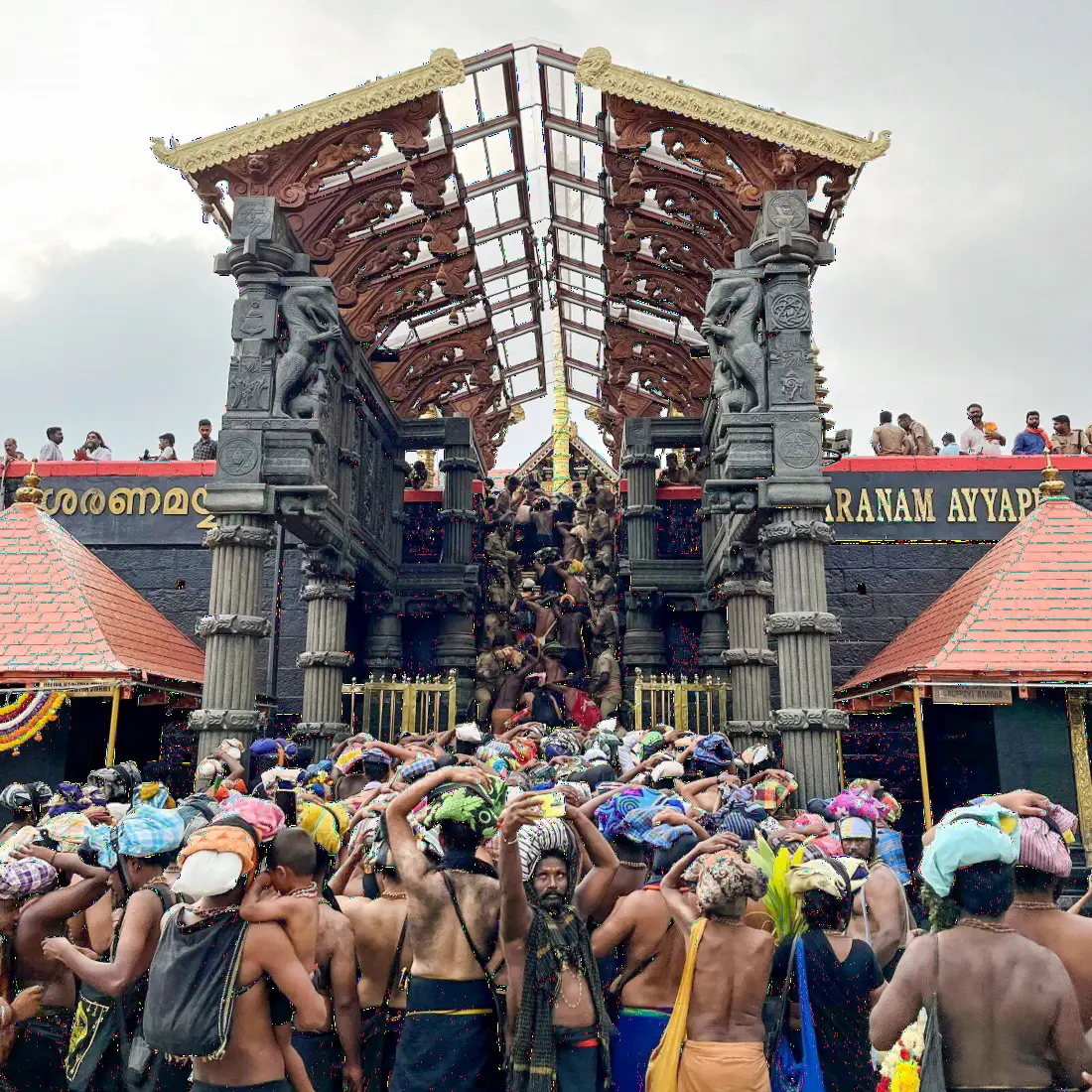
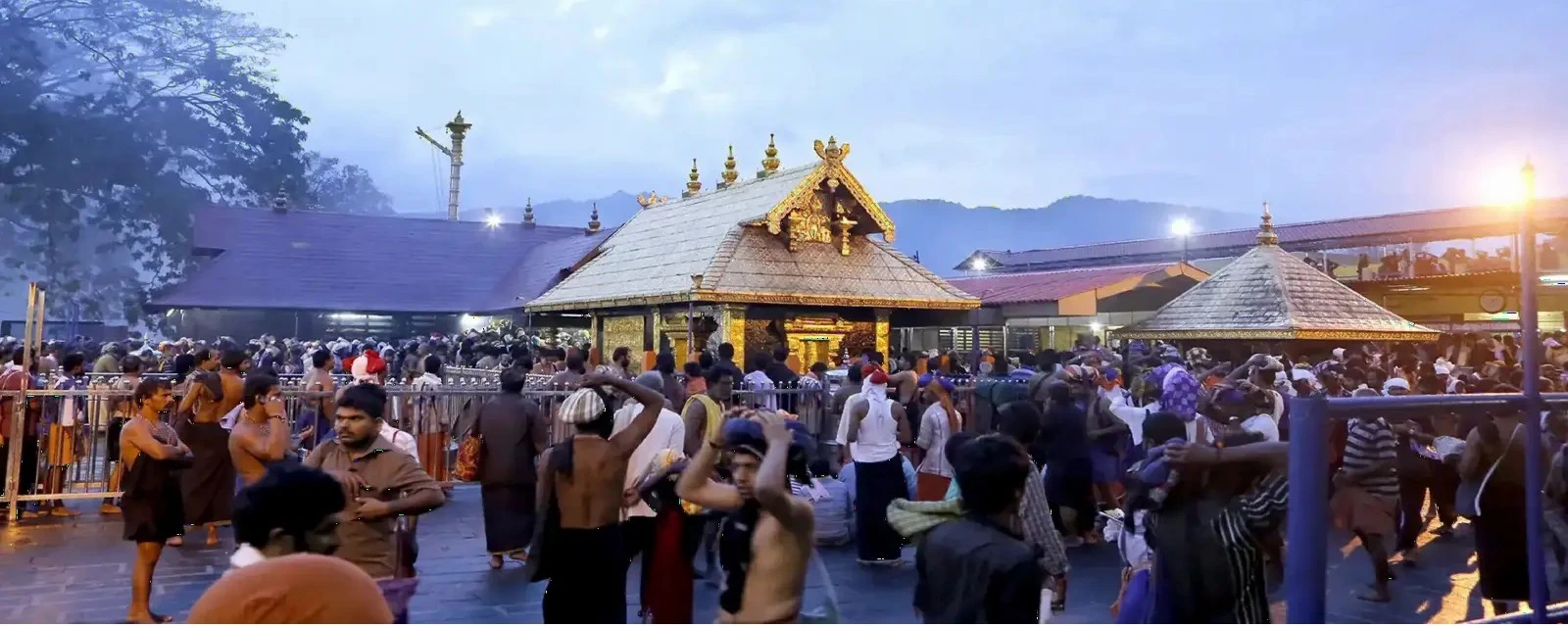
Pilgrims gathered before the Sabarimala temple at dusk
About Sabarimala

The Abode in the Forest

Sree Dharma Sastha Temple, in the evergreen heart of the Periyar Tiger Reserve, Pathanamthitta district, Keralam.

10–15 Mpilgrims each year, among the largest pilgrimages on earth
1,260 mabove sea level, ringed by eighteen hills
18sacred steps to the sanctum
41 daysof vratham before the climb
01
Where faith meets the forest

The Abode in the Forest

Where the Western Ghats rise in folds of green and the mist lingers on ancient trees, the hill shrine of Sabarimala keeps its timeless vigil. Cradled in the evergreen heart of the Periyar Tiger Reserve, in Pathanamthitta district of Keralam, the Sree Dharma Sastha Temple stands among the most celebrated forest shrines on earth.

Here the Lord is Kananavasan, the One who dwells in the forest. The woods around His sanctum are Poomkavanam, His sacred garden, and every creature that roams them, elephant and tiger, bird and butterfly, is counted among His own subjects. Forest and faith are not two things here: the wilderness itself is part of the deity, woven into every custom of the shrine.

Tat Tvam Asi
Thou Art That

Before the shrine shine these words, the Upanishadic truth that the seeker and the sought are one. True to them, this hill rises above every barrier of caste, creed and religion and welcomes all who come in search of solace. With an estimated 10 to 15 million pilgrims each year, Sabarimala is among the largest annual pilgrimages on earth.

02
The last ascent is on foot

The Sacred Path

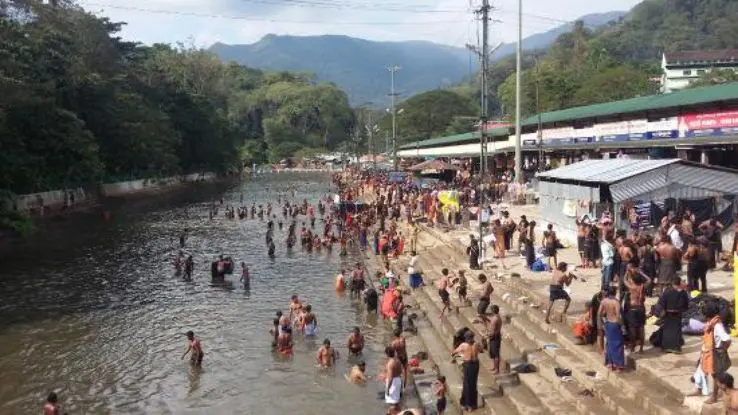
Pilgrims bathing in the Pampa river
The holy Pampa river, where the climb begins

No wheel may climb to the sanctum; the last ascent belongs to the pilgrim's own feet. Vehicles reach Pampa along the Perunad–Pampa road, laid in the 1960s for the Sabarigiri Hydroelectric Project. Beyond it, every path winds through the deep green silence of the reserve, echoing with the call of Swamiye Saranam Ayyappa.

At Pampa, about 5 km below the shrine, the holy river flows serenely past. A dip in its waters is held auspicious, and from its banks the pilgrim begins the climb to the Sannidhanam.

The traditional trekking routes

  1. 18km
    Azhuthakadavu – Pampa
  2. 5km
    Pampa – Sannidhanam
  3. 12km
    Sathram – Pullumedu – SannidhanamIdukki district
03
By road, rail and air

Roads to the Hill

Though the last ascent is made on foot, Sabarimala is woven firmly into the road network of Keralam. Every road converges on the Mannarakulanji–Chalakkayam State Highway (SH 67), which passes through Nilakkal and ends at Pampa, the last point any vehicle may reach. Three main approaches lead to it.

From the north

Erumeli route

From Ernakulam, via Vaikom, Ettumanoor, Kottayam, Kanjirappally and Erumeli (about 165 km); from Alappuzha, via Changanassery and Erumeli. Pilgrims from Karnataka (by way of Mangaluru or Mysuru) and from Tamil Nadu and Andhra Pradesh (by way of Coimbatore) reach Thrissur and continue via Muvattupuzha and Kottayam, about 210 km from Thrissur.
From the south

Chalakkayam route

From Thiruvananthapuram via Kottarakkara and Adoor, or via Kollam, Kayamkulam, Chengannur or Thiruvalla; from Nagercoil in Tamil Nadu (about 250 km) by the same road; and from Alappuzha via Thiruvalla, Kozhencherry and Pathanamthitta (about 125 km). Pilgrims from Shenkottai come by way of Punalur and Ranni.

From Madurai

Vandiperiyar route

For pilgrims from Madurai and central Tamil Nadu, via Kumily and Vandiperiyar in Idukki district, about 250 km from Madurai.

Reaching Pampa: by bus, rail and air

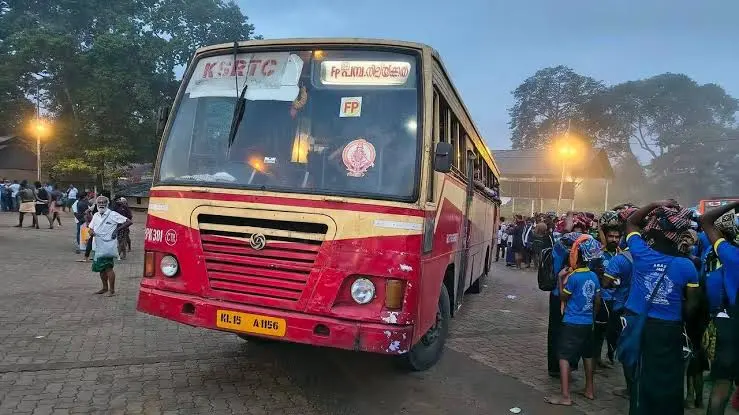
KSRTC

By bus

During the season, special services run to Pampa from depots such as Thiruvananthapuram, Kottarakkara, Punalur, Pathanamthitta, Chengannur, Kottayam, Erumeli and Kumily, along with inter-state services. Seats can be booked in advance online.

Nearest stations

By rail

No railway line reaches Sabarimala; the nearest stations are Chengannur, Thiruvalla and Kottayam, each roughly 90 km by road. Chengannur is the main alighting point, with KSRTC buses to Pampa round the clock in season. Kottayam is the most convenient for pilgrims from Mangaluru, Bengaluru, Coimbatore, Hyderabad, Mumbai and Delhi. Sabarimala special trains run through the season.

Nearest airports

By air

The nearest airports are Kochi (about 154 km by road) and Thiruvananthapuram (about 170 km). Pilgrims may also fly into Kozhikode, Coimbatore or Madurai and continue by rail or road; from Madurai the road runs via Kumily.

Rail tips. Trains that end at Ernakulam connect onward to Kottayam in about 1½ hours. Trains running via Alappuzha do not touch Kottayam: alight at Alappuzha (by road via Changanassery and Erumeli) or at Kayamkulam (via Adoor), about 125 km either way. From Thiruvananthapuram, alight at Thiruvalla or Chengannur.
04
The base camp

Nilakkal Base Camp

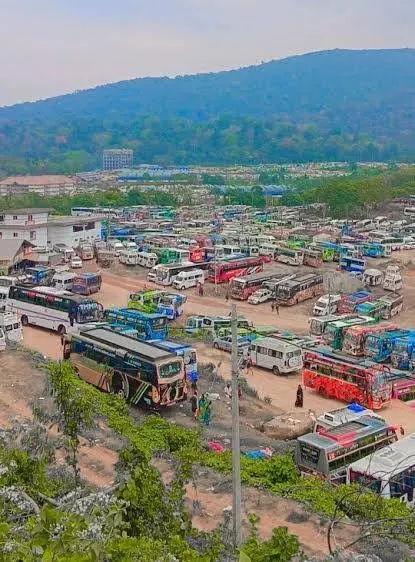
Some 22 km before Pampa, on the forested plateau of Nilakkal, the pilgrimage pauses to gather its breath. Since the floods of 2018, Nilakkal has been the base camp of the Sabarimala pilgrimage. During the season, private vehicles halt here and the pilgrim continues to Pampa by KSRTC bus.

  • Vast parking grounds for thousands of vehicles
  • A KSRTC bus station
  • Resting sheds and an annadanam hall
  • Drinking water and toilets
  • Medical care and police aid posts

The ancient Nilakkal Mahadeva Temple stands close by and has been set apart to expand the base camp under the Sabarimala Master Plan.

Aerial view of the Nilakkal parking ground full of buses and vehicles A KSRTC bus among pilgrims at Nilakkal
05
Nilakkal to Pampa

KSRTC Chain Service

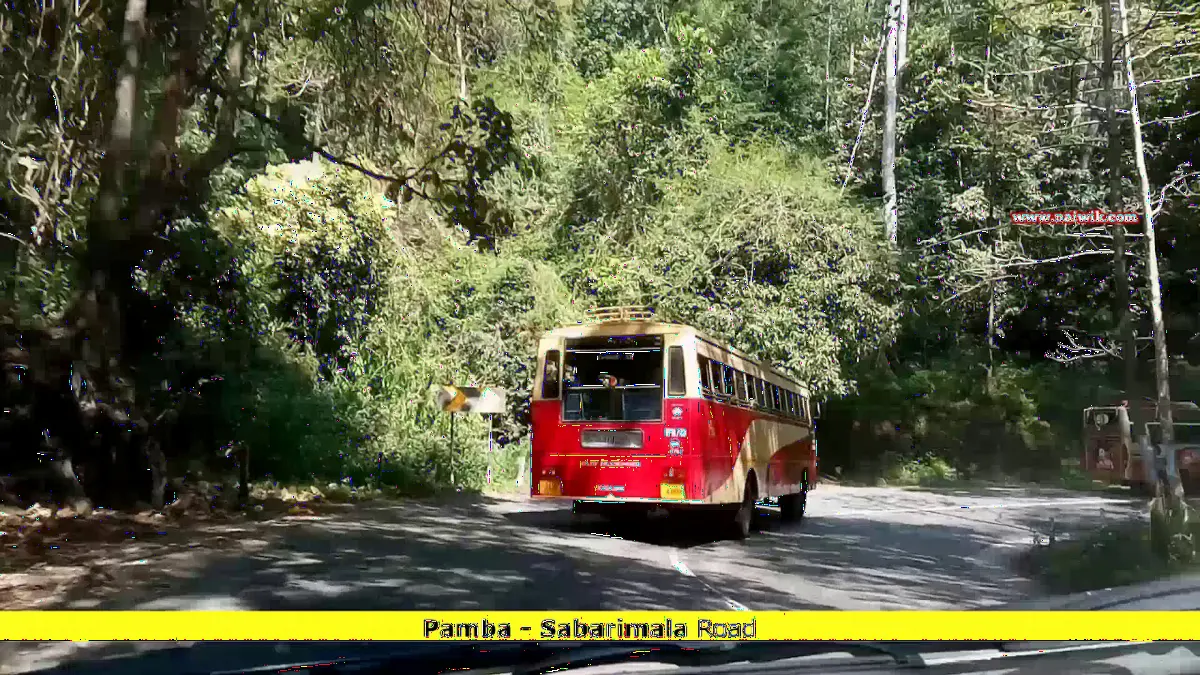
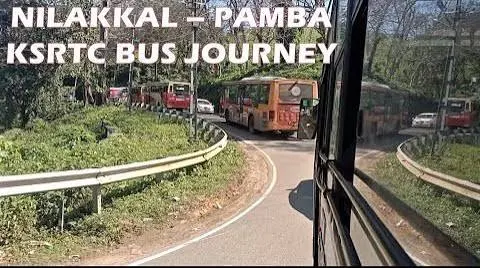
A KSRTC bus on the Pampa to Sabarimala road View from a KSRTC bus on the Nilakkal to Pampa journey

The KSRTC chain service operates between Nilakkal and Pampa to facilitate the transportation of Sabarimala pilgrims. Through the season, by day and by night, buses depart one after another, carrying pilgrims down to Pampa and back to Nilakkal, so that the banks of the holy river are spared the crush of private vehicles.

The fleet includes AC and non-AC low-floor buses, with ticket counters at both Nilakkal and Pampa.

Live KSRTC information
06
The heavenly seat

Sannidhanam: the Abode on the Hill

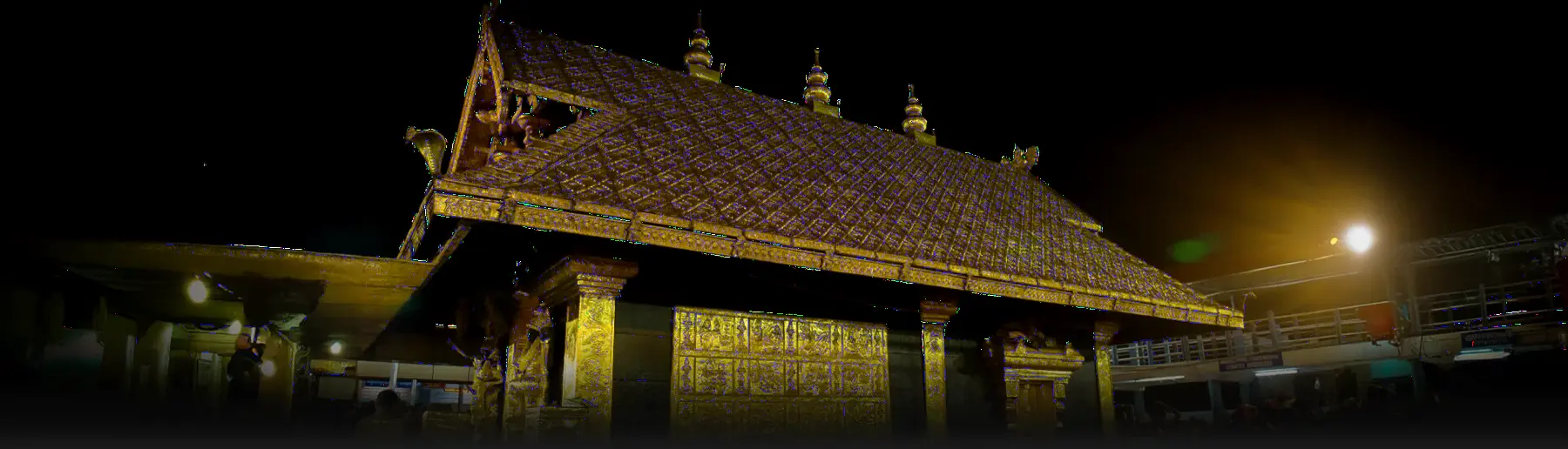
The golden roof of the Sabarimala sanctum lit at night
The gold-plated sanctum of Sabarimala by night

Crowning a hilltop some 1,260 metres above the sea, ringed by eighteen hills and wrapped in mountains and deep forest, stands the Sabarimala temple, the Sannidhanam, the heavenly seat where the Lord dwells.

Most temples and their flagstaffs stand at ground level; here the shrine and its flagstaff rise on a platform some 40 feet above the earth, so that every pilgrim must climb to meet the Lord.

Within the Sannidhanam

  • Sanctum sanctorum, its gold-plated roof crowned with four finials
  • Two mandapams
  • Balipeedam, the stone pedestals for offerings
  • Balikkalpura, the stone hall for ritual offerings
  • The gold-plated flagstaff

In 1950, a great fire consumed the ancient temple, and a new shrine rose from its ashes. Over the decades, facility upon facility has been added for the pilgrims. The idol of Lord Ayyappa, once carved in stone, is now cast in panchaloha, an alloy of five metals. In the auspicious south-west corner, the kannimoola, sits Lord Ganapathy.

At the foot of the golden steps stand the two guardians, Valiya Kadutha Swami and Karuppa Swami, with Vavar Nada close by. Having offered the ghee from their nei thenga, devotees cast the emptied coconuts into the Aazhi, the holy fire that burns below.

About a hundred metres from the Sannidhanam lie the shrine of Malikappurathamma, the Manimandapam, the shrines of Kochu Kadutha Swami and the Navagrahas, and the abode of the serpent deities, Nagaraja and Nagayakshi.

07
Pathinettampadi

The Eighteen Sacred Steps

Pilgrims with the irumudi below the eighteen sacred steps of Sabarimala

Sheathed in gold and ancient in meaning, the Pathinettampadi, the eighteen sacred steps, is the principal gateway to the shrine of Lord Ayyappa. Legend tells that the Lord asked his earthly father, the King of Pandalam, to build him a temple reached by eighteen steps.

Many meanings have gathered around the number. Some see in it the eighteen worlds, the eighteen Puranas, or the eighteen weapons with which the Lord vanquished evil; others read the five senses, six states and seven dhatus that make up the body. Eighteen is held sacred in many faiths far beyond India too.

Only those who have kept the vows of abstinence and bear the irumudi upon their heads may touch or set foot upon the holy steps.

In the most cherished reading, the pilgrim rises, one step at a time, above:

5

Panchendriyas

The five senses: sight, hearing, smell, taste and touch.

8

Ashtaragas

The eight passions: kama (desire), krodha (anger), lobha (greed), moha (attachment), asuya (jealousy), dambha (vanity), mada (pride) and matsarya (envy).

3

Trigunas

The three qualities: sattva, rajas and tamas.

2

Vidya & Avidya

Knowledge and ignorance.

5 + 8 + 3 + 2 = 18 steps

08
When the temple opens

Seasons of Pilgrimage

Vrishchikam 1Mandala – Makaravilakku season begins (mid-November)
Mid-JanuaryThe season runs to Makaravilakku
Every monthThe temple also opens for the first days of every Malayalam month

After forty-one days of vratham, bearing the sacred irumudi upon their heads, millions of devotees from across India and beyond climb this hill.

One chant, one attire: a rare shrine where devotee and deity become one in a single name, Swami.

09
Reached through discipline

Vows and Rituals of the Pilgrimage

Sabarimala is not a shrine one simply visits; it is reached through discipline. Before the journey, every pilgrim passes through a chain of sacred observances.

  1. Step one

    Malayidal

    The vow begins with the wearing of the mala, a chain of beads, often bearing a locket of Lord Ayyappa, received from a temple priest or a Guruswami, one who has made eighteen pilgrimages. From that moment the austerity begins, and the mala is removed only when the pilgrimage is complete.

  2. Forty-one days

    Mandala Vratham

    For forty-one days the devotee lives simply: celibacy, a vegetarian diet, prayer through the day, and black garments that mark detachment from the material world. Hair, beard and nails are left uncut.

  3. Eve of the journey

    Kettunirakkal

    Under the guidance of the Guruswami, the irumudi kettu is filled. Its front, the munmudi, carries the offerings for the Lord; its back, the pinmudi, the pilgrim's own needs. A coconut is emptied of its water and filled with ghee: worldly desire drained away, devotion poured in. No one without the irumudi may climb the eighteen steps.

    Ghee being filled into a coconut for the irumudi
  4. Erumeli

    Petta Thullal

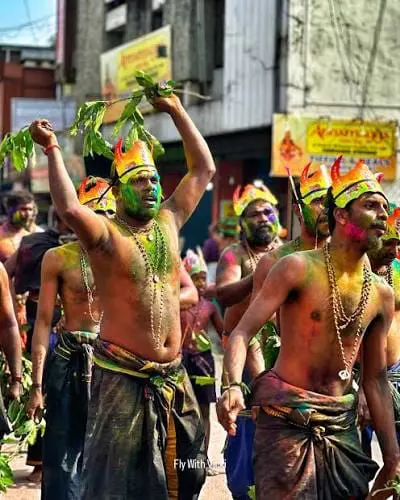
    A few days before Makaravilakku, the Ambalappuzha and Alangad groups dance through Erumeli, bodies smeared with sandal and ash, leaf-crowns on their heads, arrows in hand. The dance recalls the Lord's slaying of the demoness Mahishi and honours his companion Vavar: the Ambalappuzha group enters the Vavar mosque before setting out for the Sannidhanam, a living emblem of harmony among faiths.

    Petta Thullal dancers at Erumeli
  5. Pandalam to Sannidhanam

    Thiruvabharanam & the Ghoshayatra

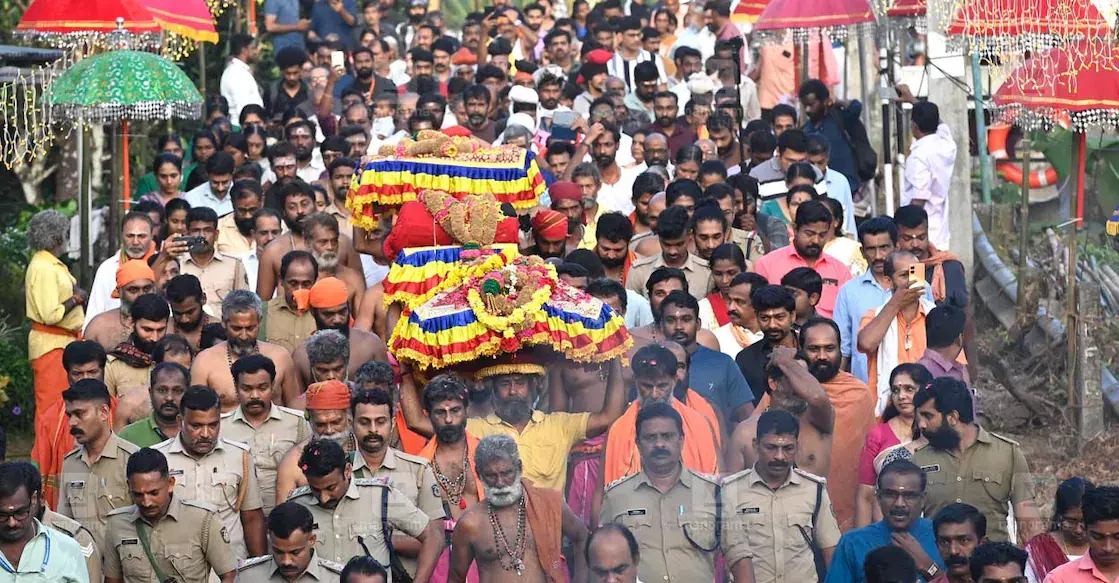
    The Thiruvabharanam, sacred gold ornaments believed to have been made by the King of Pandalam for his divine son, are kept at Pandalam. Before Makaravilakku they set out in three chests from the Valiya Koyikkal temple at Pandalam, borne in a procession of about 83 km over three days and welcomed by temple after temple along the way. On the evening of Makaravilakku they adorn the Lord before the deeparadhana.

    The Thiruvabharanam procession surrounded by devotees and police
  6. Mandala Pooja

    Thanka Anki

    For the Mandala Pooja, which crowns the forty-one days, the Lord is robed in the Thanka Anki, a golden attire of 420 sovereigns gifted in 1973 by the Maharaja of Travancore, Sree Chithira Thirunal Balarama Varma. It arrives in a chariot from the Parthasarathy temple at Aranmula, and returns there after the Pooja.

10
Custodians of the temple

Travancore Devaswom Board

The Travancore Devaswom Board (TDB), constituted in 1949 at the integration of Travancore and Cochin and governed by the Travancore–Cochin Hindu Religious Institutions Act, 1950, is the custodian of Sabarimala. Of the more than a thousand temples in its care, Sabarimala is the jewel in its crown.

The Board

  • Conducts the poojas and rituals according to tradition, under the guidance of the Thantri
  • Prepares and distributes the prasadam, Aravana and Appam, and manages offerings
  • Maintains the temple precincts and pilgrim amenities at Sannidhanam, Pampa and Nilakkal: resting sheds, drinking water, toilets and accommodation
  • Serves annadanam, the sacred offering of food
  • Safeguards the temple's properties and revenues
11
The guardian hand

Government of Keralam

Each pilgrimage season is a vast undertaking into which flows the care of the entire State. Through the Devaswom Department, the Government of Keralam oversees and supports the Board, and reviews preparations at the highest level. Many departments join hands toward one purpose.

PoliceCrowd regulation, security and traffic
HealthHospitals, emergency medical and cardiac care centres along the path, oxygen parlours
ForestProtection of Poomkavanam and safety on the forest routes
KSRTCThe Nilakkal – Pampa chain service and long-distance services
PWD, Kerala Water Authority & KSEBRoads, drinking water and power
Fire & Rescue, Revenue & Disaster Management, Civil Supplies, Legal MetrologySafety, preparedness, supplies and fair measure
12
The watch on the ground

District Administration, Pathanamthitta

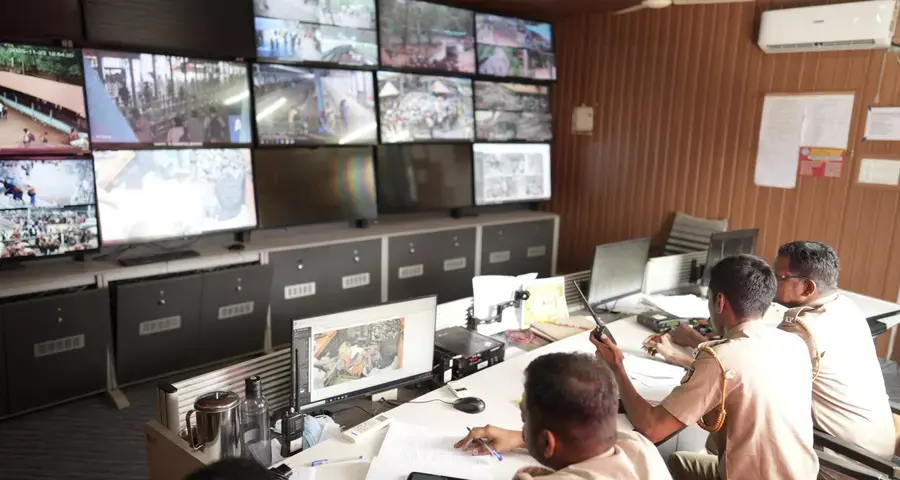
Officers at the integrated control room monitoring live camera screens
The control room keeps watch over the whole pilgrim route

Sabarimala, Pampa and Nilakkal all lie within Pathanamthitta, and so the District Administration is the nerve centre of the pilgrimage, the steady hand that turns plans into the pilgrim's safe passage.

  • District Collector, as District Magistrate and Chairperson of the District Disaster Management Authority (DDMA), leads the coordination of every department.
  • ADM Sabarimala and Executive Magistrates at Sannidhanam, Pampa and Nilakkal keep order and coordinate on the spot through the season.
  • DDMA prepares for disasters, guards crowd safety and runs the emergency operations.
  • Sabarimala Sanitation Society, chaired by the District Collector, and its Vishuddhi Sena keep Poomkavanam clean.
  • Fair prices. Prices of food items are fixed, and enforcement squads guard pilgrims against overcharging.
  • Duty orders. Officers are deployed and duty orders issued for the season.

The Sabari Portal brings live information, emergency contacts and grievance redressal to every pilgrim's hand.

13
Keepers of a pure Poomkavanam

Sabarimala Sanitation Society

Each Mandala – Makaravilakku season, countless pilgrims climb to Sabarimala, and with them come traders, workers and officials, a vast human tide flowing through the Sannidhanam, Pampa and the Nilakkal base camp.

Every day leaves behind tonnes of waste, and the sanctity of the Lord's garden rests on its swift and quiet removal. When the task grew beyond what the Devaswom Board alone could bear, the Sabarimala Sanitation Society (SSS) was born in 1995, registered under the Societies Act, to keep the holy hill pure.

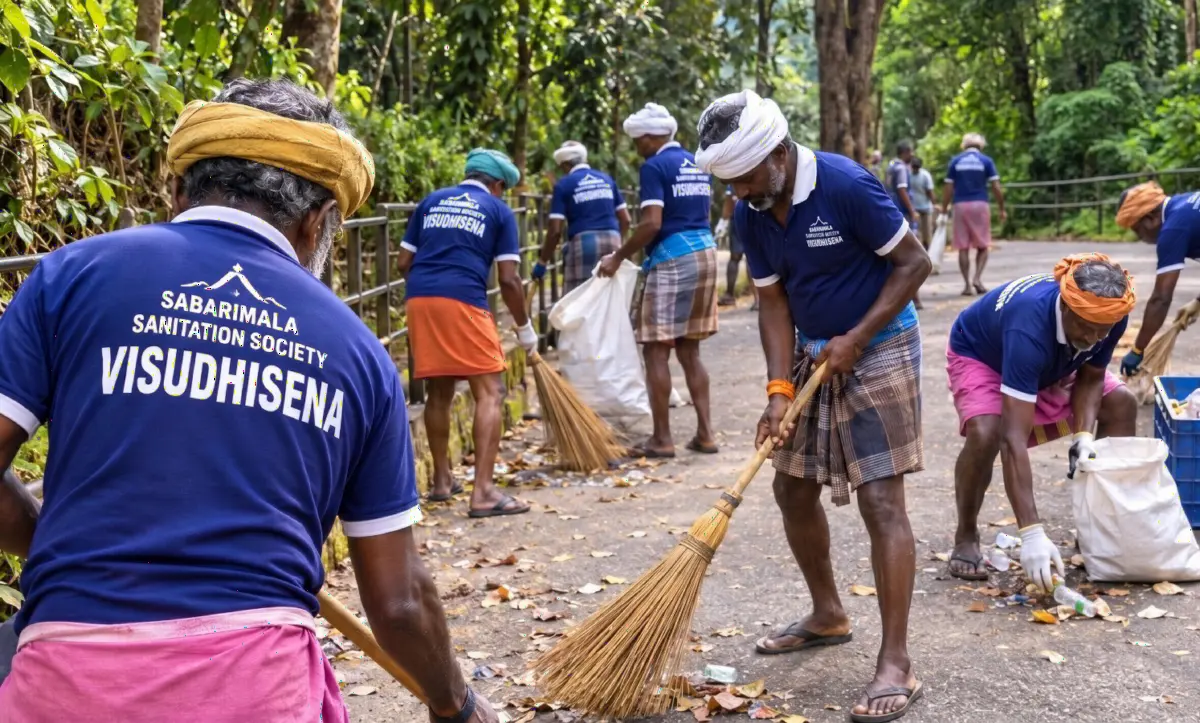
Vishuddhi Sena volunteers in blue shirts cleaning the Pampa river
Vishuddhi Sena at work in the Pampa

The Society's mission

  1. Keep Sabarimala, Pampa and their surroundings clean through the Mandala and Makaravilakku seasons
  2. Provide better sanitation facilities for pilgrims, and build the infrastructure the work requires
  3. Awaken pilgrims to personal, community and environmental hygiene through campaigns, seminars and orientation programmes
  4. Train workers in sanitation and health care at the pilgrim centres, and produce the tools and materials the work needs
  5. Raise the Vishuddhi Sena, its dedicated sanitation task force, and find sponsors for its schemes
ChairmanDistrict Collector, Pathanamthitta
Vice-ChairmanDistrict Police Chief
Member SecretaryRevenue Divisional Officer, Adoor

The Member Secretary directs the Society's work on the ground, supported by a Project Coordinator, Treasurer and Joint Secretary nominated by the Chairman.

Vishuddhi Sena workers sweeping and collecting waste on the Pampa to Sannidhanam path
Soldiers of Purity

The Vishuddhi Sena

Through the season, by day and by night, the Vishuddhi Sena tends the shrine and its approaches. Its members are engaged through the Tamil Nadu unit of the Akhila Bharatha Ayyappa Seva Sangham.

1,000strong in 2025–26, stationed at
  • Nilakkal base camp450
  • Sannidhanam300
  • Pampa210
  • Pandalam30
  • Kulanada10

A team of 155 also serves during the monthly poojas.

Order in every sector

The ground is divided into sanitation sectors. In each, dedicated workers move the gathered waste by tractor to incinerators and safe disposal points, and a Sanitation Monitoring Officer keeps watch.

14
Sannidhanamsanitation sectors
10
Pampasanitation sectors
14
Nilakkalsanitation sectors

So, unseen and unsung, a thousand hands keep the Lord's garden as pure as the faith that climbs it.

14
Poomkavanam stays green

A Plastic-Free Sabarimala

The forests of Poomkavanam have stood green for ages untold, and the Pampa has flowed clear since time out of mind. Plastic is a stranger here, and an unkind one. It does not decay; it lingers for hundreds of years, choking streams, smothering the forest floor, and finding its way into the stomachs of elephants, deer and the countless creatures the Lord counts as His own.

Plastic is banned at Sabarimala. By order of the High Court of Kerala, plastic is prohibited at the Sannidhanam, Pampa and the Nilakkal base camp. Executive Magistrates lead regular inspections to enforce the ban, and the use or sale of plastic in these areas invites action.

How every pilgrim can honour the ban

  • Fill your irumudi without plastic: use cloth, paper or natural wrappings for the offerings and your own belongings.
  • Carry water in a steel or reusable bottle, not a plastic one.
  • Use cloth bags in place of plastic covers.
  • Do not carry plastic sheets, cups, plates or packaged items into the forest.
  • If you have any plastic with you, carry it back out. Never leave it on the path, at the Sannidhanam or in the Pampa.

The irumudi was always meant to be pure, a bundle of devotion, not of waste. Climb the hill with nothing that the forest cannot bear, and leave it as green as the Lord keeps it.

A word to the pilgrim

Walk gently through Poomkavanam

Leave no plastic behind, keep the forest clean, let the wild ones be and heed the guidance of the officials. Hand this hill on to the next generation just as you found it.

Swamiye Saranam Ayyappa